

The process
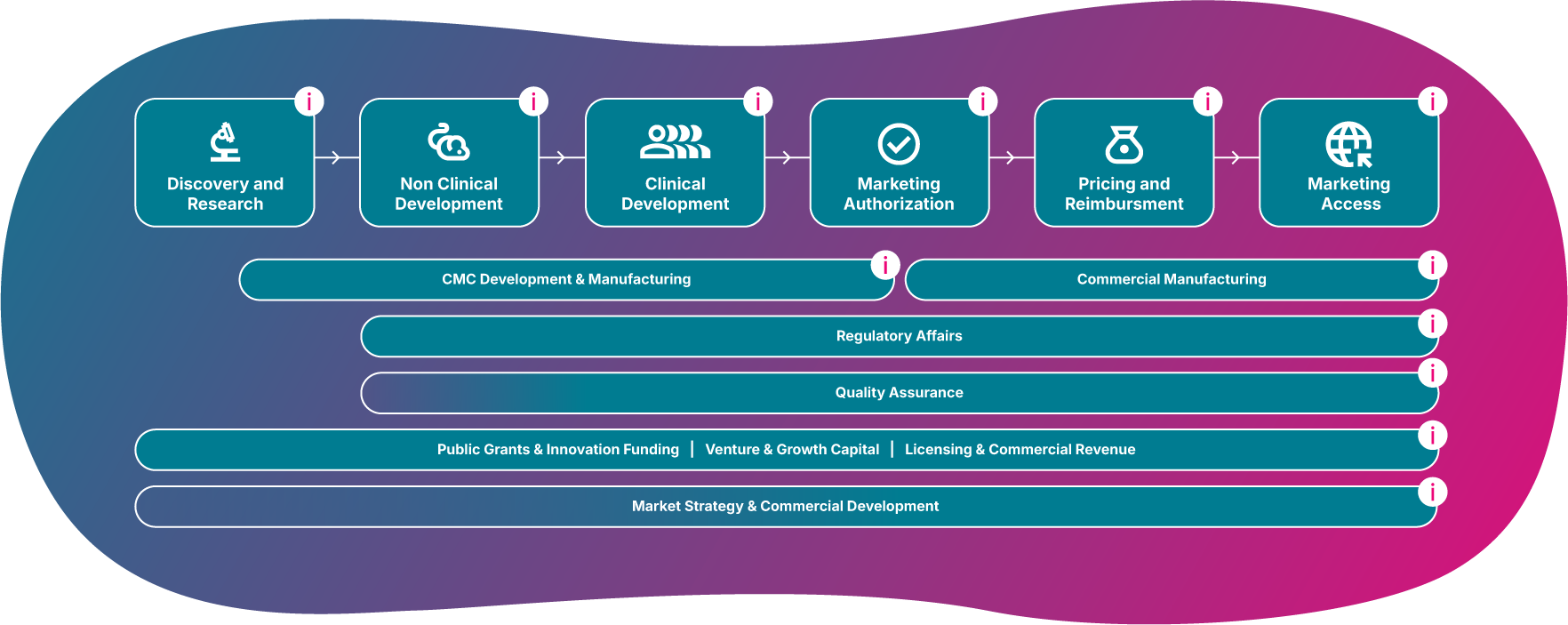
The drug development process for ATMPs.
Click on each process step to get a short description of what it entails
Discovery and Research
In the early stage of ATMP development, activitiesfocus on identifying and testing new therapeutic concepts. Scientists explore hypotheses and work to demonstrate proof-of-concepts by understanding how the treatment works and showing that it has the intended effect in laboratory studies. This stage also includes developing methods to analyze and characterize the product to ensure consistent quality and performance for the future.
Non Clinical Development
Following the early discovery and research phase, non-clinical development is carried out to further assess the safety and biological activity of the ATMP, before it is tested in humans. This includes laboratory studies in vivo and in vitro. These studies help researchers to understand how the treatment behaves in a biological system and identify any potential risks. A Clinical Trial Application (CTA) approval is needed before continuing this step into Clinical development.
Clinical Development
In the clinical development stage, the ATMP is evaluated in human participants to generate evidence of its safety and therapeutic benefit. Clinical studies are designed to understand how the treatment performs in patients, identify potential risks, and determine appropriate dosing and administration strategies. This stage also involves collecting data to demonstrate that the therapy provides meaningful clinical benefit (potency) while continuing to build the quality, safety, and efficacy profile required for regulatory approval.
CMC Development manufacturing
Chemistry Manufacturing & Controls uses Quality by Design to establishing the manufacturing process, potency of product, quality controls, and analytical methods needed to consistently produce the ATMP. Running in parallel with product and clinical development, this work ensures that the therapy can be manufactured reliably, remains stable throughout its lifecycle, and meets regulatory quality requirements. As knowledge of the product grows, manufacturing processes and control strategies are continuously refined to support clinical studies and prepare for future commercialization.
Quality Assurance
Quality Assurance underpins the entire ATMP development journey by ensuring that quality systems, processes, and documentation are established and maintained throughout the product lifecycle. QA supports compliance with regulatory requirements, promotes traceability and data integrity, and helps manage risks associated with development and manufacturing. As the therapy advances toward clinical use, approval, and market access, quality oversight becomes increasingly critical to ensuring patient safety and product reliability.
Regulatory Affairs
Regulatory Affairs guides the ATMP development process by ensuring that activities align with regulatory requirements and expectations. Working across the product lifecycle, RA supports regulatory strategy, interactions with health authorities, and the preparation of submissions required to advance development milestones. By helping teams navigate an evolving regulatory landscape, RA facilitates efficient development and supports the generation of the evidence needed for clinical development, market authorization, and patient access.
Marketing Authorization
At the marketing authorization stage, regulatory authorities evaluate the complete body of evidence generated during development, including quality, non-clinical, and clinical data. The goal is to demonstrate that the ATMP meets the required standards for quality, safety, and efficacy and that its benefits outweigh any potential risks. A successful evaluation results in authorization to place the therapy on the market, enabling the next steps toward patient access and commercialization.
Commercial Manufacturing
In the commercial manufacturing stage, the ATMP is produced to support routine patient treatment following regulatory approval. Manufacturing activities are conducted under Good Manufacturing Practice (GMP) to ensure consistent product quality, safety, and regulatory compliance. Robust manufacturing processes, quality controls, and supply chain systems are essential to provide a reliable supply of the therapy and ensure that patients receive the product as intended.
Pricing and Reimbursment
Following marketing authorization, the value of the ATMP is assessed to determine how it will be priced and reimbursed within healthcare systems. This process evaluates factors such as clinical benefit, unmet medical need, cost-effectiveness, and long-term patient outcomes to demonstrate the therapy’s value to patients and society. Successful pricing and reimbursement decisions are essential for enabling patient access and ensuring that the treatment can be adopted in clinical practice.
Marketing Access
Market access focuses on ensuring that approved ATMPs can reach the patients who need them. This involves working with healthcare providers, payers, and other stakeholders to support the adoption and implementation of the therapy in clinical practice. Activities may include establishing treatment pathways, ensuring manufacturing and supply capabilities, and addressing practical challenges related to the delivery of advanced therapies. The goal is to enable timely and sustainable patient access to innovative treatments.
Public Grants & Innovation Funding | Venture & Growth Capital | Licensing & Commercial Revenue
The development of ATMPs requires substantial financial resources over many years. Different sources of funding support the product at different stages, including public grants and innovation funding in the early phases, venture and growth capital during development, and commercial revenues or licensing agreements as the therapy approaches the market. Securing adequate funding throughout the development journey is essential to sustain research, clinical studies, manufacturing scale-up, and commercialization.
Market Strategy & Commercial Development
Market strategy and commercial development guide decisions throughout ATMP development to ensure that the therapy addresses a clear medical need and can be successfully adopted within healthcare systems. This includes evaluating the competitive landscape, engaging key stakeholders, developing commercial partnerships, and planning for future market access and growth. The goal is to create a pathway that supports both patient benefit and long-term commercial sustainability.